Best Air Compressor for a Home Garage (2026): Picks by What You Actually Run
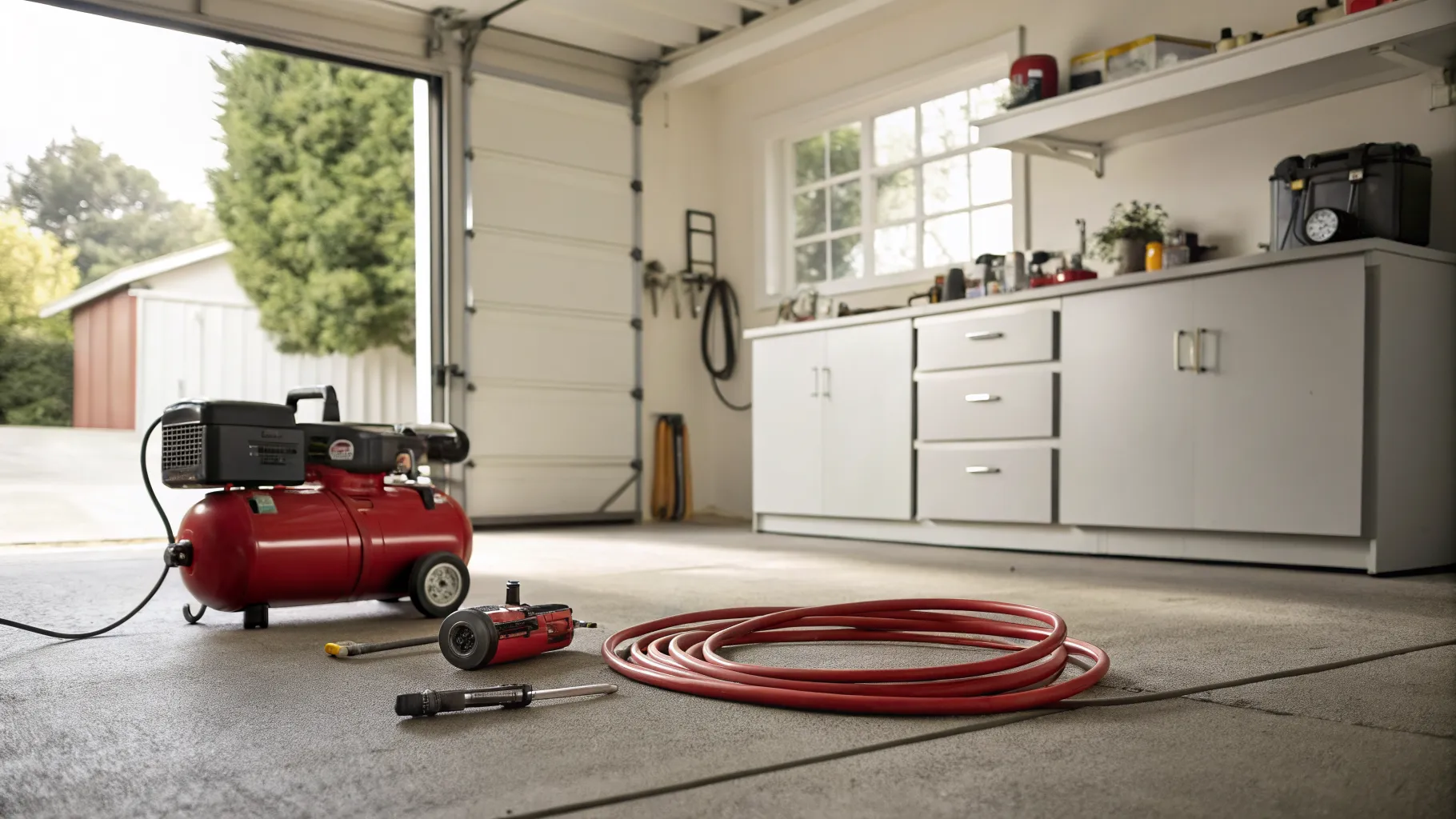
The fastest way to pick the right garage compressor is to ignore horsepower and look at one number: CFM at 90 PSI. That spec tells you whether the machine can actually feed your tools or leave you waiting. Inflation and nailing barely sip air. Impact wrenches gulp it. A random orbital sander drinks more than any portable compressor on this list can pour.
So forget “biggest tank wins.” Match the compressor to the thirstiest tool you plan to run, add a margin, and you’re done. Here are the picks, grouped by the job.
Quick reference: pick by your tools
| Your main jobs | Best pick | Why |
|---|---|---|
| Tires, brad/finish nailing, occasional framing nailer | DeWALT DWFP55126 (6 gal pancake) | 165 PSI stores more usable air per cycle |
| Same, but in an attached garage where noise matters | California Air Tools 8010 (8 gal) | About 60 dBA, you can talk over it |
| Tightest budget, basic garage tasks | Porter-Cable C2002 (6 gal pancake) | Proven, cheap, light at 34 lbs |
| Regular 1/2” impact wrench and ratchet work | Makita MAC2400 (4.2 gal) | 4.2 CFM at 90 keeps up where pancakes can’t |
| Floor space and a plan to grow into bigger tools | Industrial Air ILA1883054 (30 gal) | 5.7 CFM at 90 on a standard 120V outlet |
Best overall for a home garage: DeWALT DWFP55126
This is the one most people should buy. It’s a 6 gallon pancake, oil-free, rated 2.6 SCFM at 90 PSI, and it cranks the tank to 165 max PSI. That higher tank pressure is the real advantage over a 150 PSI pancake: more compressed air banked between cycles, so a nailer or tire chuck pulls from the reserve longer before the pump kicks back on.
Who it’s for: brad, finish, and framing nailers, inflating tires, blowing out parts, and light air-tool bursts. The 2.6 SCFM at 90 PSI is plenty for a framing nailer (about 2.2 CFM, intermittent) and inflation (under 1 CFM). Oil-free means no oil to check, and it starts in cold weather.
Honest limits: it’s loud, roughly 78 to 79 dBA, so wear hearing protection and expect it to annoy the household. It runs a 3/8” impact wrench in short bursts but can’t keep up with sustained impact or ratchet work, and it won’t touch an air sander. [Check current price]
Best quiet pick for an attached garage: California Air Tools 8010
If your garage shares a wall with the house, this is the pick. The 8010 runs at about 60 dBA, near a normal conversation, versus the roughly 78 dBA of a standard pancake. That gap is the difference between “the whole house knows you’re working” and “you can talk over it.”
Who it’s for: attached garages, evening projects, shared spaces, and anyone tired of ear protection for routine nailing and inflation. It’s an 8 gallon steel tank, 2.2 CFM at 90 PSI (3.1 at 40 PSI), 120 max PSI, oil-free, on wheels. The bigger tank buys recovery time, which helps offset the lower output.
Honest limits: the 120 PSI max stores slightly less air per cycle than a 150 or 165 PSI pancake, so it recovers more often under load. Output sits a hair below the pancakes too, so it’s a nailing-and-inflation machine, not an impact-wrench machine, and it can’t sustain an air sander. See the full California Air Tools 8010 spec sheet. [Check current price]
Want portability over tank size? The California Air Tools 4610AC uses the same quiet pump in a 4.6 gallon aluminum twin-stack at 44 lbs. It cycles more often but is easier to carry around the garage.
Best budget: Porter-Cable C2002
The long-running cheap pancake that still does the job. It’s a 6 gallon, oil-free unit at 2.6 SCFM at 90 PSI, 150 max PSI, and just 34 lbs. It nails and inflates exactly as well as the pricier pancakes; the trade-offs are no quiet motor (loud 78 dBA) and a 150 PSI ceiling that stores a little less air than the DeWALT’s 165. The Bostitch BTFP02012 is mechanically near-identical and often ships with a hose and accessory kit, so price the two together and grab whichever is cheaper that week. Either way it’s a starter machine, not an impact-wrench tool. [Check current price]
Best for impact wrenches and air tools: Makita MAC2400
When pancakes start cycling nonstop because you’re leaning on a 1/2” impact wrench, step up to the MAC2400. Makita’s “Big Bore” twin-stack is rated 4.2 SCFM at 90 PSI, nearly double a pancake, which is what it takes to keep up with an impact wrench instead of waiting on the tank.
Who it’s for: automotive work, suspension and brake jobs, anyone running 1/2” impacts, air ratchets, and cutoff bursts more than occasionally. It’s a 4.2 gallon twin-stack, 4.2 SCFM at 90 PSI (4.8 at 40), 2.5 HP, oil-lubricated with a cut-out around 130 PSI. A 1/2” impact wants 4 to 5 CFM at 90 PSI in bursts, so this one clears that bar with margin, and oil lubrication means quieter running per CFM and longer pump life.
Honest limits: it’s heavy at around 80 lbs and loud, not a quiet-series machine. Being oil-lubricated, you check and keep the oil level right (see our air compressor oil guide). And even at 4.2 CFM it cannot run a DA sander continuously. [Check current price]
Best to grow into: Industrial Air ILA1883054 (30 gal vertical)
Have floor space and bigger plans? This 30 gallon vertical delivers real shop-grade airflow on a normal household outlet. It’s rated 5.7 CFM at 90 PSI (7.0 at 40), 155 max PSI, with a cast-iron pump, and it runs on a standard 120V circuit (convertible to 240V later).
Who it’s for: anyone doing long impact-wrench or ratchet sessions, or buyers who’d rather buy once and grow into the tank than upgrade in a year. The 30 gallon tank plus 5.7 CFM at 90 lets you lean on air tools for long stretches without the constant cycling that plagues a 6 gallon pancake, and the 120V outlet is the headline: real airflow without an electrician.
Honest limits: it’s a heavy unit at roughly 185 lbs, on wheels but really a roll-it-into-place-and-leave-it machine. The cast-iron pump is oil-lubricated, so it needs the same oil checks as the Makita. And like everything here, it won’t feed a DA sander continuously. [Check current price]
How to choose for a garage
CFM at 90 PSI, not horsepower. Air tools are rated in CFM at 90 PSI, so that’s the spec that decides what you can run. Horsepower gets marketed loosely and tells you little about real output. Buy roughly 20 to 30 percent more CFM than your highest-demand tool needs. Manufacturer guides like the Quincy air pressure guide and the VMAC air tool CFM chart lay out tool-by-tool demands. Not sure how it adds up? Run your tools through our air compressor size calculator.
Tank size affects recovery, not power. A bigger tank gives a larger air reserve before the pump has to catch up; a 6 gallon empties fast under a continuous tool while a 30 gallon lets you work longer between cycles. Tank size buys time; CFM buys the ability to do the job at all.
Mind the duty cycle. Air-tool CFM ratings assume about a 25 percent duty cycle, meaning the tool runs roughly a quarter of the time. Run it flat out and real demand climbs well past the sticker number. That’s the trap behind “it should be enough on paper but it can’t keep up.” Leave margin.
120V circuit limits. Every pick here runs on a standard 120V household outlet, including the 30 gallon Industrial Air, which is the appeal. Once you go to a 60 gallon two-stage like the Quincy QT-54 (around 15.4 CFM at 90 PSI), you need a 240V circuit and likely an electrician. Know your outlet before you buy big.
Noise, especially in an attached garage. Standard pancakes run about 78 to 79 dBA, loud enough to need hearing protection and irritate the household. The California Air Tools models and Makita Quiet Series sit near 60 dBA. If your garage shares a wall with living space, the quiet pick pays for itself.
Already own a compressor that’s struggling? The fix isn’t always a new machine; see our air compressor repair guide first, and browse the rest of our tools and guides. Heading to a jobsite instead of a fixed garage? Start with our best portable air compressors roundup.
Frequently asked questions
How many gallons do I need for a home garage? For nailers and inflation, 6 gallons is plenty. For regular impact-wrench and ratchet work, step up to 20 to 30 gallons so you’re not waiting on the pump. Tank size affects recovery time, not power; CFM at 90 PSI decides what a compressor can actually run.
What CFM do I need to run an impact wrench? A 3/8” impact needs about 3 to 4 CFM at 90 PSI, and a 1/2” impact wants 4 to 5, both intermittent. A pancake at 2.6 CFM manages short bursts; for steady work, a 4 CFM-plus machine like the Makita MAC2400 keeps up.
Why can’t my compressor run an air sander? A DA or random orbital sander needs roughly 11 to 14 CFM at 90 PSI, continuously, not in bursts. No portable compressor here provides that. Continuous sanding, cutoff wheels, and sandblasting need a 30 to 60 gallon two-stage compressor.
Oil-free or oil-lubricated, which is better for a garage? Oil-free units (most pancakes, all California Air Tools, the Makita Quiet Series) need no oil maintenance and are fine for garage duty. Oil-lubricated units (the MAC2400, 30 gallon verticals) run quieter per CFM and last longer at higher duty, but you maintain the oil. For light use, oil-free is simpler; for heavy air-tool use, oil-lubricated earns its keep.
Are “quiet” compressors worth it for an attached garage? Yes, if noise reaches living space. A standard pancake at about 78 dBA needs ear protection and carries through walls. A quiet unit near 60 dBA lets you hold a conversation over it. For an attached garage or evening projects, the difference is real.
Will it run on a normal 120V outlet? Every pancake and quiet pick here runs on a standard 120V outlet, and so does the 30 gallon Industrial Air. Only the larger 60 gallon two-stage compressors, like the Quincy QT-54, need a 240V circuit.
What’s the real difference between a 6 gallon and a 20 gallon for me? The 6 gallon is light, cheap, and covers nailing and inflation, but it cycles often under any real air tool. A 20 to 30 gallon vertical gives a much larger air reserve, so you can run impact wrenches and ratchets longer without the pump constantly catching up. Mostly nailing, the 6 gallon is enough; running wrenches often, size up.
More from Air Compressor Mag
Best Portable Air Compressors: Picks by Job (2026)
Real portable air compressor picks by job, from tire inflation to framing, with the CFM at 90 PSI, tank size, and noise specs that actually decide it.
CFM Explained: How to Choose a High CFM Air Compressor for Your Tools
How to read CFM ratings and pick a high CFM air compressor: the 90 PSI standard, SCFM, a tool chart, and when you need 10, 20 or 50 CFM.
Best 30 Gallon Air Compressors for Workshops
The best 30 gallon air compressor picks for a home workshop, compared on CFM, max PSI, single-stage pumps and 120V wiring so you match the unit to your tools.