Air Compressor Accessories: Everything You Need to Get Started
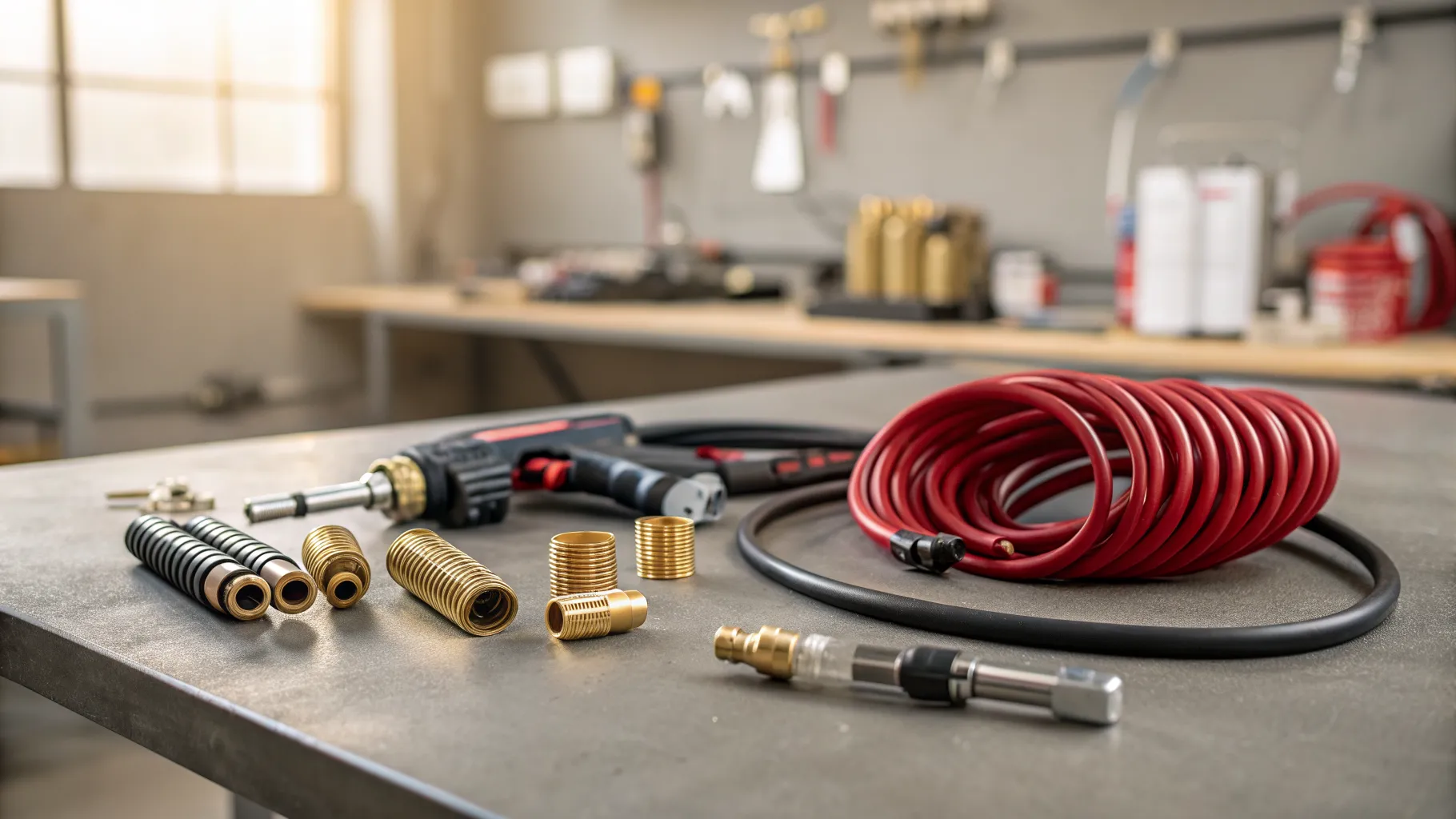
Most air compressor accessories guides are a shopping list. This one starts with the thing that actually goes wrong: you buy a compressor, buy a hose, buy a nailer, get everything home, and the plug will not seat in the coupler. Both are quarter inch. Both are brass. Neither works. Nothing on the box told you why. Understanding the coupler standards is worth more than any list of gadgets, so that is where we will start.
Coupler styles: the part that catches everyone
A quick-connect has two halves. The coupler is the female socket on your hose or compressor. The plug (or nipple) is the male end on your tool. The catch is that “1/4 inch” describes the thread, not the profile, and the profile is what decides whether they mate.
There are five interchange standards in common North American use:
- Industrial, or M-style (also called Milton style). The most common in North America and the widest accessory selection. This is your default.
- Automotive, or T-style. Slightly different internal geometry. Common on tire shop equipment.
- ARO, or A-style (sometimes called type B).
- High flow, or V-style. Looks like industrial but with a larger bore for more airflow.
- Lincoln, or L-style. Mostly grease and lube equipment.
These are not interchangeable. An industrial plug will not seat properly in an automotive coupler even though the thread size matches. That is the whole mystery, and it is why the fitting aisle is full of confused people.
Two ways out:
- Standardize on one profile and stay there. Industrial (M-style) is the sensible choice in the US for availability alone. Buy a bag of plugs, put one on every tool you own, and never think about it again.
- Use a universal coupler. V-style couplers are designed to accept A, T and M style plugs, and Milton’s 5 In ONE universal couplers connect to all five major interchanges. This is the fix for a shop that already has a drawer of mismatched tools.
The universal coupler is the better answer if you inherited tools from three sources. If you are starting fresh, pick industrial and be disciplined about it.
Hoses and sizing
Hose is where quiet performance losses live. Air loses pressure over distance, and a hose too narrow for the run starves the tool at the far end. A framing nailer will fire anyway; an impact wrench or a sander will just feel weak, and you will blame the compressor.
Rough guidance:
- Runs under 25 feet: 1/4 inch fittings with 3/8 inch hose handles most tools.
- Runs over 50 feet: go 3/8 inch throughout, fittings included. A 3/8 inch hose choked by 1/4 inch fittings at both ends is a 1/4 inch system with extra steps.
Work out your own numbers with our air hose size and pressure drop calculator before buying a long hose.
Material matters less than people argue about, but briefly: rubber is heavy, stays flexible in cold, and lies flat. PVC is cheap, light, and turns into a coil of wire in winter. Hybrid polymer splits the difference and is what most people should buy. Recoil hose is for a bench where the hose lives, not for dragging around a job.
Air treatment: filter, regulator, separator
Compressed air is hot, wet and sometimes oily. That is not a defect, it is physics: compressing air condenses the water out of it. Your tools and especially your paint care about this.
Regulator. Tank pressure is not tool pressure. A regulator holds output at what you set regardless of what the tank is doing between cycles. Nearly every tool has a maximum inlet pressure and exceeding it is how you destroy a nailer. This is not optional equipment.
Water separator. Pulls liquid water out of the stream. Essential for anything you spray, valuable for tool life, and cheap. Our water separator guide covers placement, which matters more than the unit you buy.
Coalescing filter. Removes oil aerosols and fine mist. You need one for spray painting or food-grade work. For a garage running impact tools and a blow gun, you do not.
Filter/regulator combo. One body doing separation and regulation with a gauge. For most home shops this is the right purchase, and it saves fittings and leak points versus two separate units.
The genuinely essential small parts
The unglamorous stuff that turns a compressor into a working system:
- Quick-connect couplers and plugs. At least 2 couplers and 4 to 6 plugs, all one profile. Plugs are cheap; put one on everything.
- NPT adapters in common sizes, especially 1/4 to 3/8 reducers.
- PTFE thread tape. See below.
- A hose repair fitting. Hoses fail at the ends. A repair fitting saves a whole hose.
- Blow gun. The accessory you will use more than any tool you bought the compressor for.
- Tire chuck and inflator with a gauge. If you have a bike with presta valves, you need the adapter too.
- Drain valve or petcock upgrade. Draining the tank is the single maintenance task that decides whether your tank rusts out in six years or lasts thirty. A ball valve instead of the stock petcock makes you actually do it.
Thread tape: the five second job people skip
NPT threads are tapered and seal by deforming against each other. They leave micro-gaps. Wrap PTFE tape 3 to 5 turns clockwise before threading, and the gaps fill.
Skip it and you get a system that bleeds down overnight, so the compressor kicks on at 2am and you assume the check valve failed. Nine times out of ten it is an untaped fitting. Air leaks also make the pump run more, which costs you money and pump life.
Wrap clockwise as viewed from the open end of the male thread, so that screwing it in tightens the tape rather than unwinding it.
NPT vs BSP
If you buy fittings online you will eventually receive BSP by mistake. NPT uses a 60 degree thread angle; BSP uses 55 degrees, and the pitches differ. They are not directly compatible. They will start threading together and feel almost right, which is the dangerous part. North America is NPT. Check the listing.
What to skip
- Big accessory kits. The 40-piece blister packs are mostly adapters you will never use, in a profile you may not want, at quality that leaks. Buy good couplers individually.
- Coalescing filters, unless you spray.
- Desiccant dryers, unless you spray or run air tools in a humid climate professionally. A separator handles the rest.
- Inline oilers, if your tools are the modern oil-free kind. Check before adding one, because oiling a tool that does not want oil ruins it.
Frequently asked questions
What air compressor accessories do I actually need to start? A hose sized for your longest run, a regulator (ideally a filter/regulator combo), two couplers, four to six plugs all in one profile, PTFE thread tape, and a blow gun. That is a working system. Everything else is task-specific.
Why won’t my air hose plug fit the coupler? Because the profiles differ, not the sizes. Industrial (M-style), automotive (T-style), ARO (A-style), high flow (V-style) and Lincoln (L-style) all come in 1/4 inch and none of them mate with each other. An industrial plug will not seat in an automotive coupler even though both say 1/4 inch. Either standardize on one profile or fit a universal coupler.
Which coupler style should I use? Industrial (M-style) if you are starting fresh, since it is the most common in North America with the widest accessory choice. If you already own tools with mixed plugs, buy universal couplers instead: V-style accepts A, T and M plugs, and 5-in-1 universal couplers accept all five major interchanges.
Do I need a water separator on my air compressor? Yes if you spray paint, and it is worth having regardless. Compressing air condenses water out of it, and that water carries into your tools and onto your work. A separator is cheap insurance. A coalescing filter is a separate thing and only needed for spraying or food-grade air.
What size air hose should I use? For runs under 25 feet, 3/8 inch hose with 1/4 inch fittings suits most tools. Over 50 feet, use 3/8 inch throughout including the fittings, since 1/4 inch fittings on a 3/8 inch hose reduce the whole system to the smaller size.
Why does my compressor lose pressure overnight? Usually an untaped or badly taped NPT fitting rather than a failed check valve. NPT threads are tapered and need PTFE tape wrapped 3 to 5 turns clockwise to seal. Spray soapy water on each joint and watch for bubbles before replacing any parts.
Are NPT and BSP fittings interchangeable? No. NPT has a 60 degree thread angle and BSP has 55 degrees, with different pitches. They will partially thread together and feel nearly right, which is what makes the mistake dangerous. North America uses NPT.
More from Air Compressor Mag
Best Portable Air Compressors: Picks by Job (2026)
Real portable air compressor picks by job, from tire inflation to framing, with the CFM at 90 PSI, tank size, and noise specs that actually decide it.
CFM Explained: How to Choose a High CFM Air Compressor for Your Tools
How to read CFM ratings and pick a high CFM air compressor: the 90 PSI standard, SCFM, a tool chart, and when you need 10, 20 or 50 CFM.
Best 30 Gallon Air Compressors for Workshops
The best 30 gallon air compressor picks for a home workshop, compared on CFM, max PSI, single-stage pumps and 120V wiring so you match the unit to your tools.