Die Grinder CFM: Why Makers Publish Two Numbers
The short answer: size your compressor for 8 to 10 CFM at 90 PSI if you want to run a 1/4 inch die grinder continuously, and understand that the number on the box may be 19 or 24 instead. Die grinder CFM figures contradict each other across the web because manufacturers publish two different measurements, air consumption at free speed and air consumption at load, and most articles copy whichever one they found without saying which it is.
That is the whole confusion, and once you see it the numbers stop conflicting.
The two figures, from one manufacturer’s own spec sheet
Chicago Pneumatic publishes both for the same tool, which makes the point better than any explanation. From the CP9106Q-B specification page:
| Specification | CP9106Q-B |
|---|---|
| Free speed | 23,000 rpm |
| Air consumption at free speed | 19 CFM |
| Air consumption at load | 8.7 CFM |
| Max dynamic air working pressure | 90 PSI |
| Air inlet thread | 1/4 inch |
| Minimum hose diameter, 16 ft hose | 0.38 in |
| Max power | 0.32 hp |
| Collet capacity | 1/4 in |
Free speed means the tool spinning with nothing touching the burr. The governor is wide open and the motor is drawing everything it can. Under load, the burr is in the metal, the motor slows, and consumption drops to less than half.
This is the opposite of what most people assume. With an impact wrench, load raises consumption. With a die grinder, the free-running figure is the peak, because an air motor unloaded is an air motor running flat out.
Published figures for named die grinders
Every number below is the manufacturer’s own published figure at 90 PSI. Where a maker publishes only one number, it is stated as they state it.
| Tool | Type | Free speed | Published air consumption |
|---|---|---|---|
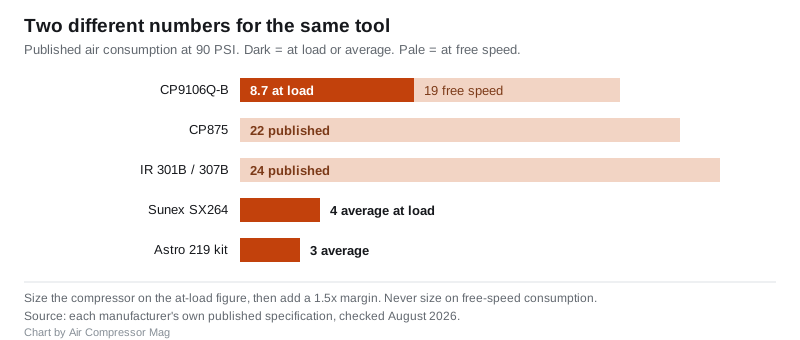
| Chicago Pneumatic CP9106Q-B | Angle | 23,000 rpm | 19 CFM free speed / 8.7 CFM at load |
| Chicago Pneumatic CP875 | Angle | 22,500 rpm | 22 CFM |
| Ingersoll Rand 301B | Right angle | 21,000 rpm | 24 CFM |
| Ingersoll Rand 307B | Straight | 28,000 rpm | 24 CFM |
| Sunex SX264 | Angle | 20,000 rpm | 4 CFM average at load |
| Astro Pneumatic 219 kit | Angle and straight | — | 3 CFM average |
Now look at that table with the free-speed distinction in mind and the spread stops being nonsense. The 19-to-24 CFM cluster is free-speed consumption. The 3-to-4.5 CFM cluster that dominates the blogs is average consumption, which assumes a duty cycle: trigger down some of the time, not all of it. The 8.7 CFM figure sits between them and is the one that matters most.
Ingersoll Rand’s 301B and 307B both list 24 CFM at 90 PSI despite one being a right-angle tool at 21,000 rpm and the other a straight tool at 28,000 rpm. That tells you the figure is governed by the motor, not the head geometry, and it is a free-flow number rather than a working one. Both also specify a 3/8 inch minimum hose, which is a bigger constraint than most users realize.
Which number sizes your compressor
Use air consumption at load, then add a margin. For most 1/4 inch die grinders that means:
- Continuous grinding, trigger down for minutes at a time: size for 8 to 10 CFM at 90 PSI, then apply the standard 1.5x margin, so a compressor rated at 12 to 15 CFM at 90 PSI. This is a two-stage machine, not a pancake.
- Intermittent work, a few seconds on and several off, deburring and cleanup: the average figure of 3 to 5 CFM is a fair guide, and a compressor delivering 6 to 8 CFM at 90 PSI with a reasonable tank will keep up.
- Never size on free-speed consumption. You would be buying a machine for a condition that only exists when you are not cutting anything.
The 1.5x margin is not padding. A compressor rated at its CFM figure is rated at 100% duty cycle in ideal conditions, and a die grinder is the single most demanding common shop tool because the trigger stays down. Our air compressor CFM guide explains where the rating comes from and why the number on the label is optimistic.
Why a die grinder empties a tank that runs everything else
Tank size buys you time, not capacity, and a die grinder is the tool that exposes the difference.
An impact wrench pulls hard for two seconds and then stops while you move to the next lug. A 20 gallon tank absorbs that easily. A die grinder pulls 8 to 10 CFM for as long as your hand is on the lever, which might be two minutes. Once the tank drops to the cut-in pressure, you are running on what the pump makes, and if the pump makes 6 CFM and the tool wants 9, pressure falls, the tool slows, and the burr starts rubbing instead of cutting.
The tell is easy to recognize: the grinder starts strong and dies away after 20 or 30 seconds. That is not a worn tool, it is an undersized compressor. Our air tool CFM chart puts the die grinder alongside the other common tools so you can see where it sits.
Two practical points that cost nothing:
- Use 3/8 inch hose, not 1/4 inch. Both Ingersoll Rand and Chicago Pneumatic specify a 0.38 inch minimum hose diameter on these tools. A 1/4 inch hose, or a 1/4 inch coupler on a 3/8 inch hose, chokes the tool no matter what the compressor is doing. Restrictive quick-couplers are the most common hidden bottleneck in a home shop.
- Check pressure at the tool, not at the tank. All of these figures are at 90 PSI at the inlet. If the regulator reads 90 and there is 25 feet of undersized hose between it and your hand, the tool is not seeing 90.
Collet size changes the answer
The figures above are for 1/4 inch collet tools, which is what most people mean by a die grinder. Two variants shift the numbers:
- 1/8 inch collet pencil grinders run smaller motors and consume less, typically in the 3 to 4 CFM average range, and are genuinely usable on a modest compressor.
- Extended-reach and 1/2 inch collet grinders are larger motors with correspondingly higher consumption, and belong in a shop sized for continuous production work rather than a garage.
If you are choosing a compressor around a die grinder rather than choosing a grinder around a compressor, our CFM for impact wrench page covers the other tool people underestimate, and the two together usually set the size of the machine.
Frequently asked questions
How many CFM does a die grinder need? Size for 8 to 10 CFM at 90 PSI for continuous use and apply a 1.5x margin, so a compressor delivering 12 to 15 CFM at 90 PSI. For intermittent deburring and cleanup, 6 to 8 CFM at 90 PSI is workable. The 3 to 4.5 CFM figures widely quoted are average consumption across a duty cycle, not continuous demand.
Why do die grinder CFM specs vary so much? Because manufacturers publish two different measurements. Chicago Pneumatic’s CP9106Q-B lists 19 CFM at free speed and 8.7 CFM at load for the same tool. Articles that copy one figure without labeling it produce the contradictions you see across search results. Free speed is the peak, at load is the working figure, and average assumes a duty cycle.
Can I run a die grinder on a pancake compressor? Not continuously. A typical pancake compressor delivers well under half what a 1/4 inch die grinder needs with the trigger held down, so you get 20 to 30 seconds of useful work and then the pressure falls away. For short bursts of deburring it will do; for grinding a weld it will not.
Does a smaller die grinder use less air? Yes. A 1/8 inch collet pencil grinder runs a smaller motor and typically sits in the 3 to 4 CFM average range, which is why it is the realistic choice on a small compressor. Stepping up to a 1/4 inch collet tool roughly doubles the demand.
What size hose does a die grinder need? 3/8 inch. Both Ingersoll Rand and Chicago Pneumatic specify a 0.38 inch minimum hose diameter for their 1/4 inch die grinders over a 16 foot run. A 1/4 inch hose or a restrictive quick-coupler will starve the tool regardless of how large the compressor is.
Is a die grinder harder on a compressor than an impact wrench? Yes, in practice, even though an impact wrench has a higher peak draw. The impact wrench pulls hard for a second or two at a time and the tank absorbs it. A die grinder holds its demand for as long as the lever is down, so the compressor’s continuous output, not the tank size, determines whether the tool keeps cutting.
More from Air Compressor Mag
Best Portable Air Compressors: Picks by Job (2026)
Real portable air compressor picks by job, from tire inflation to framing, with the CFM at 90 PSI, tank size, and noise specs that actually decide it.
CFM Explained: How to Choose a High CFM Air Compressor for Your Tools
How to read CFM ratings and pick a high CFM air compressor: the 90 PSI standard, SCFM, a tool chart, and when you need 10, 20 or 50 CFM.
Best 30 Gallon Air Compressors for Workshops
The best 30 gallon air compressor picks for a home workshop, compared on CFM, max PSI, single-stage pumps and 120V wiring so you match the unit to your tools.