Pneumatic Cylinder Air Consumption Calculator (CFM)
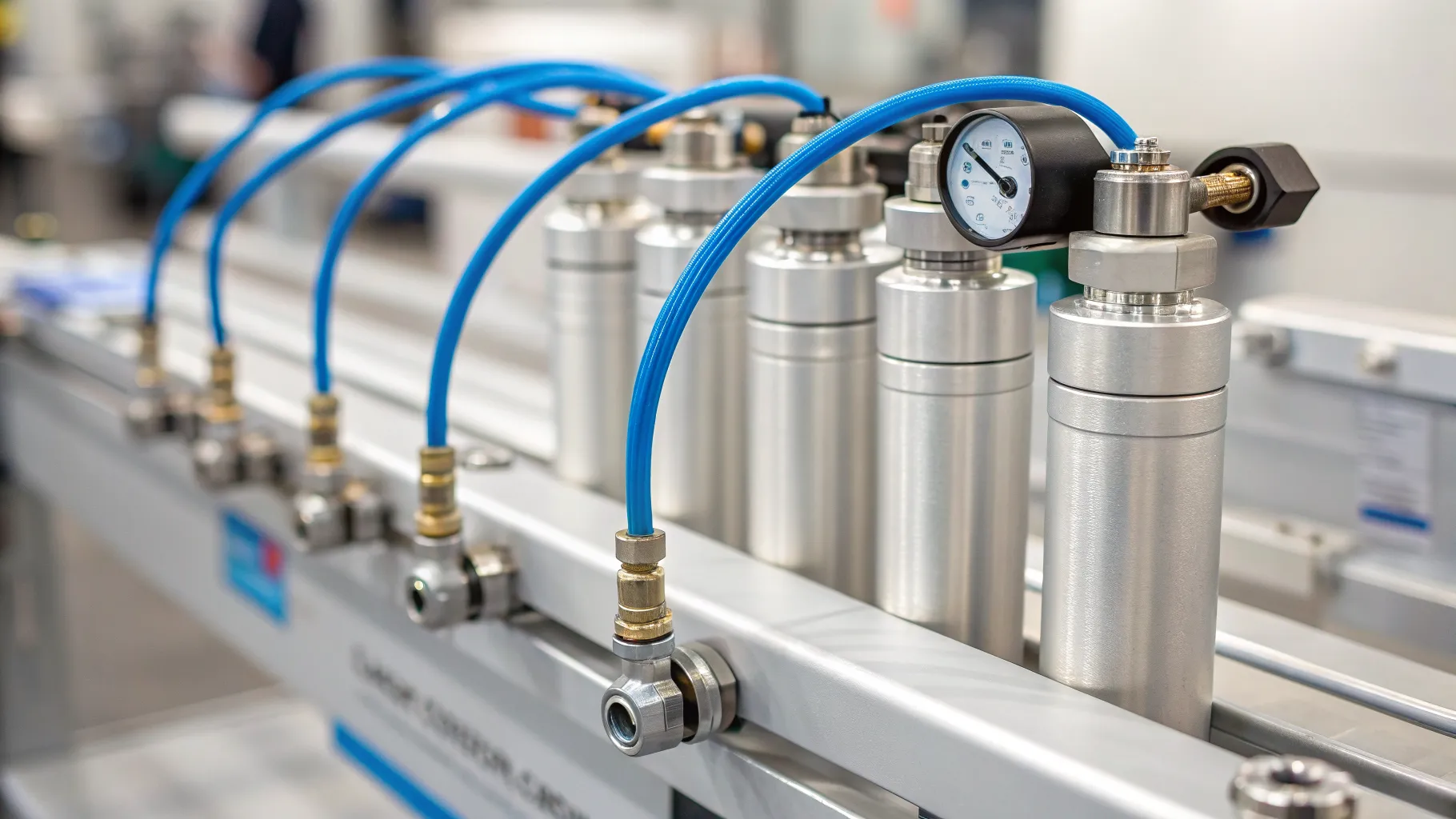
An air cylinder uses a fixed amount of air every stroke: the swept volume of the bore, squeezed up to your line pressure. Multiply that by how many times it cycles a minute and you have the free air your compressor has to deliver, in the same CFM units the compressor is rated in. The detail most quick estimates miss is that the retract stroke uses less air than the extend stroke, because the piston rod takes up part of the bore, and that the tubing between the valve and the cylinder is filled and dumped on every stroke too. This calculator handles both.
Cylinder details
Tubing between valve and cylinder (optional, per port)
Sizing
How the calculation works
The extend stroke fills the full bore: area = π × bore² ÷ 4, times the stroke length. The retract stroke fills the ring around the rod: π × (bore² − rod²) ÷ 4, times the stroke. A single-acting cylinder only takes air on the extend stroke, because a spring pushes it back and the air is exhausted.
That volume is at line pressure, so it is converted to free air (the air at atmospheric pressure that a compressor's CFM rating describes) by multiplying by the compression ratio: (gauge pressure + 14.7) ÷ 14.7 in PSI, or (gauge bar + 1.013) ÷ 1.013 in bar. Free air per cycle, times cycles per minute, times the number of cylinders, gives the CFM figure.
Worked example: a 2 inch bore, 5/8 inch rod, 6 inch stroke, double-acting cylinder at 80 PSI uses 18.85 cubic inches on the extend stroke and 17.01 on the retract stroke. At a compression ratio of 6.44 that is about 0.134 cubic feet of free air per cycle, so 10 cycles a minute needs about 1.34 CFM.
Why the tubing matters
Every time the valve shifts, the line from the valve to the cylinder port is pressurized and then exhausted along with the cylinder. On short-stroke, small-bore cylinders with long runs of tubing, that line can use a large share of the total air. Mounting the valve close to the cylinder is the simplest way to cut it. The tube field asks for inside diameter, not the outside size that tubing is sold by, so check the tubing maker's spec sheet.
Using the result
The figure is average consumption. A compressor rated at or above the "size for" number, measured at a pressure above your operating pressure, should keep up with the cylinders. The headroom setting is there because real systems also lose air through leaks, regulators and blow-off, and other tools on the same line take their share; how much to add is a judgment call for your shop. If the cylinders fire in bursts, a receiver tank near the machine smooths out the peaks, and you can size one with our receiver tank size calculator. The calculation ignores the small volume inside the cylinder end caps and ports, and it assumes the cylinder reaches full line pressure each stroke, which is true for most machines running at normal speeds.
More from Air Compressor Mag
Best Portable Air Compressors: Picks by Job (2026)
Real portable air compressor picks by job, from tire inflation to framing, with the CFM at 90 PSI, tank size, and noise specs that actually decide it.
CFM Explained: How to Choose a High CFM Air Compressor for Your Tools
How to read CFM ratings and pick a high CFM air compressor: the 90 PSI standard, SCFM, a tool chart, and when you need 10, 20 or 50 CFM.
Best 30 Gallon Air Compressors for Workshops
The best 30 gallon air compressor picks for a home workshop, compared on CFM, max PSI, single-stage pumps and 120V wiring so you match the unit to your tools.