How to Choose an Air Compressor: The Complete Buyer’s Guide
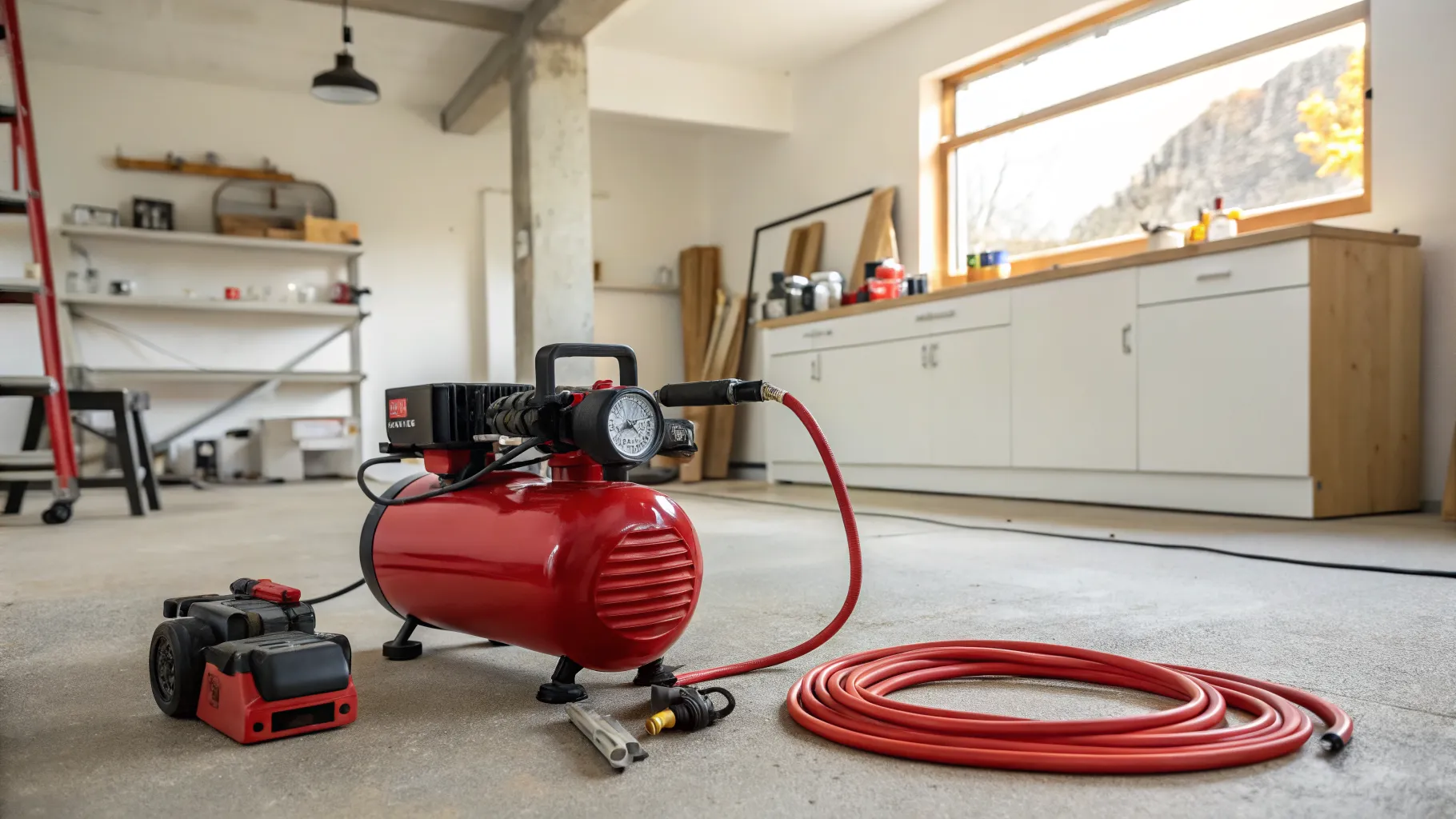
Compressed air buying decisions go wrong for one reason more than any other: people shop by horsepower. Manufacturers know it, which is why a “6.5 HP” compressor sits on a shelf next to a 15-amp wall plug that physically cannot deliver 6.5 running horsepower. The number that actually decides whether your tools work is CFM at 90 PSI. Get that right and the rest of the spec sheet falls into place. Get it wrong and you will own a compressor that stalls every time you pull the trigger on an impact wrench.
This guide walks through the specs that matter, the ones that do not, and pairs the rules with real, spec-checked models so you can match a machine to your job instead of to a marketing figure.
Start with CFM at 90 PSI, not horsepower
CFM (cubic feet per minute) is the volume of air the compressor delivers. Air tools consume air continuously while running, so the compressor has to keep up with the tool’s demand or pressure drops and the tool slows down. Every air tool publishes a CFM requirement, almost always measured at 90 PSI, so that is the number you compare against.
PSI (pounds per square inch) is pressure, not volume. Most air tools run at 90 PSI, and nearly every compressor sold can reach that easily. Higher max PSI on the tank does not make a tool run better; it mostly means the tank stores more usable air between cycles. Chasing a 200 PSI rating when your tools need 90 will not fix a CFM shortfall.
Tank size (gallons) is buffer, not output. A bigger tank lets the motor rest longer between cycles and smooths out short bursts of high demand, but it does not increase how much air the pump can make per minute. A 60-gallon tank fed by a weak pump still starves a sandblaster.
The order of importance for almost every buyer: CFM at 90 PSI first, then max PSI (90+ is plenty for tools), then tank size for buffering. Horsepower comes last, and for the reason in the next section, you can usually ignore it entirely.
The horsepower problem, and the electrical ceiling that exposes it
Here is the math that no marketing label wants you to do. A standard 15-amp, 120-volt household circuit supplies roughly 1,800 watts. An electric motor needs about 746 watts per horsepower. Divide 1,800 by 746 and you get about 2.4 horsepower. That is the absolute ceiling of running horsepower a normal wall outlet can sustain. So when a compressor that plugs into that same outlet advertises “5 HP” or “6.5 HP,” it is not publishing running horsepower. It is publishing peak horsepower.
Peak HP is the maximum the motor hits for a fraction of a second, often measured near stall on a test bench. Running HP, the figure that matters in use, is typically 60 to 80 percent of peak. Independent testing of one “6.5 HP, 10 CFM” consumer unit measured around 6 CFM of real delivery, roughly 40 percent below the claim (aircompressorzone.com).
The takeaway is simple: ignore horsepower as a comparison spec. Compare CFM at 90 PSI between machines and you sidestep the entire inflated-HP game.
CFM vs SCFM: read the fine print
You will see both CFM and SCFM on spec sheets. SCFM (standard CFM) is airflow corrected to standard conditions, commonly 14.7 PSI, around 60 to 68°F, and 36 percent relative humidity. Because it is measured at those reference conditions rather than under working pressure, SCFM is usually a higher number than airflow measured under load. The only safe comparison is apples to apples: line up every machine’s rating at the same pressure, ideally 90 PSI. If one is quoted at 40 PSI and another at 90, they are not comparable, and the 40 PSI figure is the flattering one.
How much CFM do you actually need?
Find the CFM requirement of each tool you will run, then size the compressor to the tools you will run at the same time. Here are common tool demands, all measured at about 90 PSI:
| Air tool | CFM at 90 PSI |
|---|---|
| Blow gun | about 3 |
| 1/2” impact wrench | 4 to 5 |
| 3/4” impact wrench | about 7 to 9 |
| Die grinder | about 4 to 6 (high-speed cut-off tools need more) |
| HVLP spray gun | 10 to 18 (varies by gun) |
| Sandblaster | 20+ |
Tool CFM figures from Pro Air Tools and the VMAC consumption chart.
The sizing rule of thumb
Add up the CFM of every tool you will run simultaneously, then multiply by 1.5 to give yourself headroom:
Target compressor CFM = (sum of CFM for tools run at once) x 1.5
So a single 1/2” impact wrench at 5 CFM points you to a compressor that delivers about 7.5 CFM at 90 PSI. A die grinder run continuously wants similar headroom over its rated draw. A sandblaster at 20+ CFM pushes you firmly into stationary or gas territory. Always size against the 90 PSI figure, never the 40 PSI one. A unit rated 20 CFM at 40 PSI may deliver only 14 to 15 CFM at 90, which changes which tools it can actually run.
For a step-by-step walkthrough with your specific tools, see what size air compressor do I need or run the numbers in the air compressor size calculator.
Pick by job: CFM target to verified models
This is where most buying guides stop at generic advice. Below, each tier pairs the CFM you need with real machines whose specs are confirmed on manufacturer or retailer pages.
Home, DIY, and brad nailing (1 to 3 CFM)
Trim nailing, brad nailers, tire inflation, and blow guns sip air. A small pancake or hand-carry unit is enough.
| Model | Tank | CFM @ 90 PSI | Max PSI | Noise | Lubrication | Motor |
|---|---|---|---|---|---|---|
| California Air Tools 1P1060S | 1 gal | 1.2 | 120 | 56 dBA | Oil-free | 0.6 HP / running |
| Ridgid OF60150HB | 6 gal | 2.6 | 150 | 80 dBA | Oil-free | 1.5 HP |
| Metabo HPT EC36DAQ4 (36V cordless) | 2 gal | 1.6 | 135 | 79 dBA | Oil-free | Brushless |
The California Air Tools unit stands out for being genuinely quiet at 56 dBA; the Ridgid pancake is a common value pick if you do not mind the 80 dBA bark. Model specs from Pro Tool Reviews. For more options at this tier, see best portable air compressors and best air compressor for home garage.
Contractor and trim carpentry (4 to 5 CFM)
Running a framing nailer, or two finish nailers at once, calls for a twin-stack or mid-size unit in the 4 to 5 CFM range.
| Model | Tank | CFM @ 90 PSI | Max PSI | Noise | Lubrication |
|---|---|---|---|---|---|
| Makita MAC2400 “Big Bore” | 4.2 gal | 4.2 | 130 | 79 dB | Oil-lubricated |
| DeWalt DXCMS20045US XTREME Quiet | 4.5 gal | 5.0 | 200 | 60.3 dBA | Oil-free |
| Metabo HPT EC1315SM | 8 gal | 5.0 | 225 | 76 dBA | Oil-free |
The Makita MAC2400 is the long-standing default recommendation here; note its tank is 4.2 gallons, not the 2.5 gallons it is frequently mislabeled as (confirmed on the official Makita product page). The DeWalt XTREME is unusual for pairing 5 CFM output with a 60.3 dBA noise level.
Shop, garage, and no-power jobsites (18 to 20+ CFM)
Die grinders run continuously, HVLP spray work, and any sandblasting demand serious sustained airflow. This is stationary 240V or gas territory.
| Model | Tank | CFM | Max PSI | Power |
|---|---|---|---|---|
| Rolair V5180K30 | 80 gal | 18.0 @ 175 PSI | 175 | 5 HP, 240V electric |
| Rolair 8422HK30 | 9 gal | 20.1 @ 90 PSI | 175 | Honda GX270 gas |
The 80-gallon Rolair represents the bolt-it-to-the-floor electric tier and needs a dedicated 240V circuit; the gas Rolair exists for jobsites with no power. Specs from Pro Tool Reviews and Rolair.
Single-stage vs two-stage
A single-stage compressor squeezes air once and typically tops out around 135 PSI. A two-stage compressor compresses the air twice, reaching higher pressures (up to about 175 PSI) and producing more CFM per horsepower. Single-stage covers most home and contractor work. Two-stage earns a place in shops running air-hungry tools for long stretches, where the higher pressure and efficiency matter.
Duty cycle: the spec most guides skip
Duty cycle is the share of time a compressor can run within a given period without overheating. It is rarely printed on consumer boxes, but it changes how you size.
| Type | Typical duty cycle |
|---|---|
| Single-stage reciprocating | about 50% |
| Two-stage reciprocating | about 60 to 75% |
| Industrial rotary screw | often 100% |
A 50 percent duty cycle means the unit should run no more than half the time; for every minute pumping, it wants a minute to cool. The practical rule: for a single-stage reciprocating compressor, buy about twice your actual air demand so the pump is not running flat out. Duty cycle framing from Campbell Hausfeld. If you plan to run a tool for sustained periods, this headroom matters more than tank size.
Oil-free vs oil-lubricated
The trade-off is lifespan and noise against maintenance.
| Factor | Oil-free | Oil-lubricated |
|---|---|---|
| Typical lifespan | about 2,000 hours | many times longer |
| Typical noise | 80+ dB (see exception below) | about 70 dB |
| Maintenance | None (no oil) | Periodic oil changes |
| Best for | Occasional, DIY, cold starts | Daily, heavy, continuous use |
Lifespan comparison from Quincy Compressor. For occasional garage use, oil-free is the sensible default: nothing to maintain, and you will likely never reach the 2,000-hour limit. For daily or heavy use, oil-lubricated pays back its maintenance in a far longer service life. If you go oil-lubricated, see our notes on air compressor oil for the right grade.
Noise, and the modern quiet exception
The old rule that oil-free means loud is breaking down. Standard oil-free pancakes still bark at 79 to 80 dBA, but a newer class of quiet oil-free units changes the picture. The California Air Tools 1P1060S runs at 56 dBA and the DeWalt XTREME at 60.3 dBA, both quieter than a typical oil-lubricated unit at around 70 dB. If you work in an attached garage or near neighbors, treat dBA as a real spec to compare, and know that low-noise oil-free now exists.
Tank style: pancake, hot dog, twin-stack, wheelbarrow
These names describe the tank shape, which mostly affects portability and stability rather than performance:
- Pancake: a flat round tank under the pump. Low center of gravity, stable, common on 6-gallon DIY units.
- Hot dog: a single horizontal cylinder. Slim and easy to carry.
- Twin-stack: two stacked cylinders for more capacity in a small footprint (the Makita MAC2400 style).
- Wheelbarrow: a horizontal tank with wheels and handles, built to roll around a jobsite.
Match the style to how you move the machine, then go back to comparing CFM at 90 PSI.
Voltage and circuits: 120V vs 240V
This is where the horsepower ceiling becomes practical. Anything beyond roughly 2 running horsepower cannot live on a standard 15-amp, 120V outlet. Larger stationary compressors, like the 80-gallon Rolair, require a 240V circuit, usually on a dedicated breaker. Two warnings from real-world use:
- A compressor’s startup surge can trip a breaker even when its running draw is within limits. A dedicated circuit avoids nuisance trips from other loads.
- If a “120V” unit advertises high horsepower, remember the 2.4 HP ceiling. The plug tells you the truth the label does not.
If you are buying anything in the shop tier, plan the electrical before you buy the compressor.
Tank certification: ASME and OSHA
For most home buyers this is a footnote; for anyone using a compressor in a workplace it is a legal requirement worth understanding.
ASME certification (Boiler and Pressure Vessel Code, Section VIII, Division 1, carrying a “U” or “UM” stamp) governs air tanks operating over 15 PSI in commercial or industrial use. Many jurisdictions exempt small tanks on low-horsepower home compressors, but the exemptions vary by state, so check your local rules rather than assume.
In a workplace, OSHA standard 1910.169 sets specific rules for air receivers. It requires one or more spring-loaded safety valves sized so pressure cannot exceed the maximum allowable working pressure by more than 10 percent, no shutoff valve between the receiver and its safety valve, a drain at the lowest point of the tank, and a readily visible indicating pressure gauge. The full text is on OSHA’s site. If a compressor will run in a commercial setting, confirm the tank is ASME stamped before you buy.
Frequently asked questions
What size air compressor do I need to run air tools? Find the CFM requirement of each tool at 90 PSI, add up the ones you will run at the same time, then multiply by 1.5 for headroom. A single 1/2” impact wrench needs about 4 to 5 CFM, so target roughly 7.5 CFM at 90 PSI. A sandblaster at 20+ CFM needs a stationary or gas unit.
Is a higher horsepower compressor better? Not in the way the labels suggest. A standard 15-amp, 120V outlet can sustain only about 2.4 running horsepower (1,800 watts divided by 746 watts per HP), so any “5 HP” or “6.5 HP” wall-plug compressor is quoting peak horsepower, not running. Ignore HP and compare CFM at 90 PSI instead.
What is the difference between CFM and SCFM? SCFM is airflow corrected to standard conditions (about 14.7 PSI, 60 to 68°F, 36 percent humidity), so it usually reads higher than airflow measured under working pressure. When comparing machines, line them up at the same pressure, ideally 90 PSI, so you are comparing like for like.
Is oil-free or oil-lubricated better for a home garage? For occasional DIY use, oil-free is the simpler choice: no oil to change, and you are unlikely to reach its roughly 2,000-hour lifespan. For daily or heavy use, oil-lubricated lasts far longer and runs quieter, though it needs periodic oil changes.
Why does a “6.5 HP” compressor run on a regular wall outlet? Because the 6.5 HP is a peak rating measured for a fraction of a second on a test bench, not the horsepower it sustains while running. A normal 120V circuit caps sustained output near 2.4 HP. The real-world output is the CFM figure, which is often well below what the horsepower claim implies.
Does duty cycle matter when buying? Yes, especially for tools you run continuously like die grinders. Single-stage reciprocating compressors are typically rated around 50 percent duty cycle, meaning they should run no more than half the time. The practical fix is to buy roughly twice your actual air demand so the pump is not running flat out.
More from Air Compressor Mag
Best Portable Air Compressors: Picks by Job (2026)
Real portable air compressor picks by job, from tire inflation to framing, with the CFM at 90 PSI, tank size, and noise specs that actually decide it.
CFM Explained: How to Choose a High CFM Air Compressor for Your Tools
How to read CFM ratings and pick a high CFM air compressor: the 90 PSI standard, SCFM, a tool chart, and when you need 10, 20 or 50 CFM.
Best 30 Gallon Air Compressors for Workshops
The best 30 gallon air compressor picks for a home workshop, compared on CFM, max PSI, single-stage pumps and 120V wiring so you match the unit to your tools.